
Concepts
This guide explains the core ideas behind OpenSpec and how they fit together. For practical usage, see Getting Started and Workflows.
Philosophy
Section titled “Philosophy”OpenSpec is built around four principles:
fluid not rigid — no phase gates, work on what makes senseiterative not waterfall — learn as you build, refine as you goeasy not complex — lightweight setup, minimal ceremonybrownfield-first — works with existing codebases, not just greenfieldWhy These Principles Matter
Section titled “Why These Principles Matter”Fluid not rigid. Traditional spec systems lock you into phases: first you plan, then you implement, then you’re done. OpenSpec is more flexible — you can create artifacts in any order that makes sense for your work.
Iterative not waterfall. Requirements change. Understanding deepens. What seemed like a good approach at the start might not hold up after you see the codebase. OpenSpec embraces this reality.
Easy not complex. Some spec frameworks require extensive setup, rigid formats, or heavyweight processes. OpenSpec stays out of your way. Initialize in seconds, start working immediately, customize only if you need to.
Brownfield-first. Most software work isn’t building from scratch — it’s modifying existing systems. OpenSpec’s delta-based approach makes it easy to specify changes to existing behavior, not just describe new systems.
The Big Picture
Section titled “The Big Picture”OpenSpec organizes your work into two main areas:
┌────────────────────────────────────────────────────────────────────┐│ openspec/ ││ ││ ┌─────────────────────┐ ┌───────────────────────────────┐ ││ │ specs/ │ │ changes/ │ ││ │ │ │ │ ││ │ Source of truth │◄─────│ Proposed modifications │ ││ │ How your system │ merge│ Each change = one folder │ ││ │ currently works │ │ Contains artifacts + deltas │ ││ │ │ │ │ ││ └─────────────────────┘ └───────────────────────────────┘ ││ │└────────────────────────────────────────────────────────────────────┘Specs are the source of truth — they describe how your system currently behaves.
Changes are proposed modifications — they live in separate folders until you’re ready to merge them.
This separation is key. You can work on multiple changes in parallel without conflicts. You can review a change before it affects the main specs. And when you archive a change, its deltas merge cleanly into the source of truth.
Specs describe your system’s behavior using structured requirements and scenarios.
Structure
Section titled “Structure”openspec/specs/├── auth/│ └── spec.md # Authentication behavior├── payments/│ └── spec.md # Payment processing├── notifications/│ └── spec.md # Notification system└── ui/ └── spec.md # UI behavior and themesOrganize specs by domain — logical groupings that make sense for your system. Common patterns:
- By feature area:
auth/,payments/,search/ - By component:
api/,frontend/,workers/ - By bounded context:
ordering/,fulfillment/,inventory/
Spec Format
Section titled “Spec Format”A spec contains requirements, and each requirement has scenarios:
# Auth Specification
## PurposeAuthentication and session management for the application.
## Requirements
### Requirement: User AuthenticationThe system SHALL issue a JWT token upon successful login.
#### Scenario: Valid credentials- GIVEN a user with valid credentials- WHEN the user submits login form- THEN a JWT token is returned- AND the user is redirected to dashboard
#### Scenario: Invalid credentials- GIVEN invalid credentials- WHEN the user submits login form- THEN an error message is displayed- AND no token is issued
### Requirement: Session ExpirationThe system MUST expire sessions after 30 minutes of inactivity.
#### Scenario: Idle timeout- GIVEN an authenticated session- WHEN 30 minutes pass without activity- THEN the session is invalidated- AND the user must re-authenticate
Key elements:
| Element | Purpose |
|---|---|
## Purpose |
High-level description of this spec’s domain |
### Requirement: |
A specific behavior the system must have |
#### Scenario: |
A concrete example of the requirement in action |
| SHALL/MUST/SHOULD | RFC 2119 keywords indicating requirement strength |
Why Structure Specs This Way
Section titled “Why Structure Specs This Way”Requirements are the “what” — they state what the system should do without specifying implementation.
Scenarios are the “when” — they provide concrete examples that can be verified. Good scenarios:
- Are testable (you could write an automated test for them)
- Cover both happy path and edge cases
- Use Given/When/Then or similar structured format
RFC 2119 keywords (SHALL, MUST, SHOULD, MAY) communicate intent:
- MUST/SHALL — absolute requirement
- SHOULD — recommended, but exceptions exist
- MAY — optional
What a Spec Is (and Is Not)
Section titled “What a Spec Is (and Is Not)”A spec is a behavior contract, not an implementation plan.
Good spec content:
- Observable behavior users or downstream systems rely on
- Inputs, outputs, and error conditions
- External constraints (security, privacy, reliability, compatibility)
- Scenarios that can be tested or explicitly validated
Avoid in specs:
- Internal class/function names
- Library or framework choices
- Step-by-step implementation details
- Detailed execution plans (those belong in
design.mdortasks.md)
Quick test:
- If implementation can change without changing externally visible behavior, it likely does not belong in the spec.
Keep It Lightweight: Progressive Rigor
Section titled “Keep It Lightweight: Progressive Rigor”OpenSpec aims to avoid bureaucracy. Use the lightest level that still makes the change verifiable.
Lite spec (default):
- Short behavior-first requirements
- Clear scope and non-goals
- A few concrete acceptance checks
Full spec (for higher risk):
- Cross-team or cross-repo changes
- API/contract changes, migrations, security/privacy concerns
- Changes where ambiguity is likely to cause expensive rework
Most changes should stay in Lite mode.
Human + Agent Collaboration
Section titled “Human + Agent Collaboration”In many teams, humans explore and agents draft artifacts. The intended loop is:
- Human provides intent, context, and constraints.
- Agent converts this into behavior-first requirements and scenarios.
- Agent keeps implementation detail in
design.mdandtasks.md, notspec.md. - Validation confirms structure and clarity before implementation.
This keeps specs readable for humans and consistent for agents.
Changes
Section titled “Changes”A change is a proposed modification to your system, packaged as a folder with everything needed to understand and implement it.
Change Structure
Section titled “Change Structure”openspec/changes/add-dark-mode/├── proposal.md # Why and what├── design.md # How (technical approach)├── tasks.md # Implementation checklist├── .openspec.yaml # Change metadata (optional): schema, created, skip_specs, retire_capabilities└── specs/ # Delta specs └── ui/ └── spec.md # What's changing in ui/spec.mdEach change is self-contained. It has:
- Artifacts — documents that capture intent, design, and tasks
- Delta specs — specifications for what’s being added, modified, or removed
- Metadata — optional configuration for this specific change
Why Changes Are Folders
Section titled “Why Changes Are Folders”Packaging a change as a folder has several benefits:
-
Everything together. Proposal, design, tasks, and specs live in one place. No hunting through different locations.
-
Parallel work. Multiple changes can exist simultaneously without conflicting. Work on
add-dark-modewhilefix-auth-bugis also in progress. -
Clean history. When archived, changes move to
changes/archive/with their full context preserved. You can look back and understand not just what changed, but why. -
Review-friendly. A change folder is easy to review — open it, read the proposal, check the design, see the spec deltas.
Artifacts
Section titled “Artifacts”Artifacts are the documents within a change that guide the work.
The Artifact Flow
Section titled “The Artifact Flow”proposal ──────► specs ──────► design ──────► tasks ──────► implement │ │ │ │ why what how steps + scope changes approach to takeArtifacts build on each other. Each artifact provides context for the next.
Artifact Types
Section titled “Artifact Types”Proposal (proposal.md)
Section titled “Proposal (proposal.md)”The proposal captures intent, scope, and approach at a high level.
# Proposal: Add Dark Mode
## IntentUsers have requested a dark mode option to reduce eye strainduring nighttime usage and match system preferences.
## ScopeIn scope:- Theme toggle in settings- System preference detection- Persist preference in localStorage
Out of scope:- Custom color themes (future work)- Per-page theme overrides
## ApproachUse CSS custom properties for theming with a React contextfor state management. Detect system preference on first load,allow manual override.
When to update the proposal:
- Scope changes (narrowing or expanding)
- Intent clarifies (better understanding of the problem)
- Approach fundamentally shifts
Specs (delta specs in specs/)
Section titled “Specs (delta specs in specs/)”Delta specs describe what’s changing relative to the current specs. See Delta Specs below.
Design (design.md)
Section titled “Design (design.md)”The design captures technical approach and architecture decisions.
# Design: Add Dark Mode
## Technical ApproachTheme state managed via React Context to avoid prop drilling.CSS custom properties enable runtime switching without class toggling.
## Architecture Decisions
### Decision: Context over ReduxUsing React Context for theme state because:- Simple binary state (light/dark)- No complex state transitions- Avoids adding Redux dependency
### Decision: CSS Custom PropertiesUsing CSS variables instead of CSS-in-JS because:- Works with existing stylesheet- No runtime overhead- Browser-native solution
## Data Flow```ThemeProvider (context)       │       ▼ThemeToggle ◄──► localStorage       │       ▼CSS Variables (applied to :root)```
## File Changes- `src/contexts/ThemeContext.tsx` (new)- `src/components/ThemeToggle.tsx` (new)- `src/styles/globals.css` (modified)
When to update the design:
- Implementation reveals the approach won’t work
- Better solution discovered
- Dependencies or constraints change
Tasks (tasks.md)
Section titled “Tasks (tasks.md)”Tasks are the implementation checklist — concrete steps with checkboxes.
# Tasks
## 1. Theme Infrastructure- [ ] 1.1 Create ThemeContext with light/dark state- [ ] 1.2 Add CSS custom properties for colors- [ ] 1.3 Implement localStorage persistence- [ ] 1.4 Add system preference detection
## 2. UI Components- [ ] 2.1 Create ThemeToggle component- [ ] 2.2 Add toggle to settings page- [ ] 2.3 Update Header to include quick toggle
## 3. Styling- [ ] 3.1 Define dark theme color palette- [ ] 3.2 Update components to use CSS variables- [ ] 3.3 Test contrast ratios for accessibility
Task best practices:
- Group related tasks under headings
- Use hierarchical numbering (1.1, 1.2, etc.)
- Keep tasks small enough to complete in one session
- State how each task is verified (a test, command, or observable result)
- Land the tests and documentation each group’s work calls for inside that group, not in a final catch-up group
- Check tasks off as you complete them
Delta Specs
Section titled “Delta Specs”Delta specs are the key concept that makes OpenSpec work for brownfield development. They describe what’s changing rather than restating the entire spec.
The Format
Section titled “The Format”# Delta for Auth
## ADDED Requirements
### Requirement: Two-Factor AuthenticationThe system MUST support TOTP-based two-factor authentication.
#### Scenario: 2FA enrollment- GIVEN a user without 2FA enabled- WHEN the user enables 2FA in settings- THEN a QR code is displayed for authenticator app setup- AND the user must verify with a code before activation
#### Scenario: 2FA login- GIVEN a user with 2FA enabled- WHEN the user submits valid credentials- THEN an OTP challenge is presented- AND login completes only after valid OTP
## MODIFIED Requirements
### Requirement: Session ExpirationThe system MUST expire sessions after 15 minutes of inactivity.(Previously: 30 minutes)
#### Scenario: Idle timeout- GIVEN an authenticated session- WHEN 15 minutes pass without activity- THEN the session is invalidated
## REMOVED Requirements
### Requirement: Remember Me(Deprecated in favor of 2FA. Users should re-authenticate each session.)Delta Sections
Section titled “Delta Sections”| Section | Meaning | What Happens on Archive |
|---|---|---|
## ADDED Requirements |
New behavior | Appended to main spec |
## MODIFIED Requirements |
Changed behavior | Replaces existing requirement |
## REMOVED Requirements |
Deprecated behavior | Deleted from main spec; removing the last requirement retires the capability and deletes its spec file, when the change declares retire_capabilities: true |
## Purpose |
What a brand-new capability is for | Seeds the Purpose of the main spec being created; ignored when the spec already exists |
Why Deltas Instead of Full Specs
Section titled “Why Deltas Instead of Full Specs”Clarity. A delta shows exactly what’s changing. Reading a full spec, you’d have to diff it mentally against the current version.
Conflict avoidance. Two changes can touch the same spec file without conflicting, as long as they modify different requirements.
Review efficiency. Reviewers see the change, not the unchanged context. Focus on what matters.
Brownfield fit. Most work modifies existing behavior. Deltas make modifications first-class, not an afterthought.
Schemas
Section titled “Schemas”Schemas define the artifact types and their dependencies for a workflow.
How Schemas Work
Section titled “How Schemas Work”name: spec-drivenartifacts: - id: proposal generates: proposal.md requires: [] # No dependencies, can create first
- id: specs generates: specs/**/*.md requires: [proposal] # Needs proposal before creating
- id: design generates: design.md requires: [proposal] # Can create in parallel with specs
- id: tasks generates: tasks.md requires: [specs, design] # Needs both specs and design firstArtifacts form a dependency graph:
proposal (root node) │ ┌─────────────┴─────────────┐ │ │ ▼ ▼ specs design (requires: (requires: proposal) proposal) │ │ └─────────────┬─────────────┘ │ ▼ tasks (requires: specs, design)Dependencies are enablers, not gates. They show what’s possible to create, not what you must create next. You can skip design if you don’t need it. You can create specs before or after design — both depend only on proposal.
Built-in Schemas
Section titled “Built-in Schemas”spec-driven (default)
The standard workflow for spec-driven development:
proposal → specs → design → tasks → implementBest for: Most feature work where you want to agree on specs before implementation.
Custom Schemas
Section titled “Custom Schemas”Create custom schemas for your team’s workflow:
# Create from scratchopenspec schema init research-first
# Or fork an existing oneopenspec schema fork spec-driven research-first
Example custom schema:
name: research-firstartifacts:  - id: research    generates: research.md    requires: []           # Do research first
  - id: proposal    generates: proposal.md    requires: [research]   # Proposal informed by research
  - id: tasks    generates: tasks.md    requires: [proposal]   # Skip specs/design, go straight to tasks
See Customization for full details on creating and using custom schemas.
Archive
Section titled “Archive”Archiving completes a change by merging its delta specs into the main specs and preserving the change for history.
What Happens When You Archive
Section titled “What Happens When You Archive”Before archive:
openspec/├── specs/│ └── auth/│ └── spec.md ◄────────────────┐└── changes/ │ └── add-2fa/ │ ├── proposal.md │ ├── design.md │ merge ├── tasks.md │ └── specs/ │ └── auth/ │ └── spec.md ─────────┘
After archive:
openspec/├── specs/│ └── auth/│ └── spec.md # Now includes 2FA requirements└── changes/ └── archive/ └── 2025-01-24-add-2fa/ # Preserved for history ├── proposal.md ├── design.md ├── tasks.md └── specs/ └── auth/ └── spec.mdThe Archive Process
Section titled “The Archive Process”-
Merge deltas. Each delta spec section (ADDED/MODIFIED/REMOVED) is applied to the corresponding main spec.
-
Move to archive. The change folder moves to
changes/archive/with a date prefix for chronological ordering. -
Preserve context. All artifacts remain intact in the archive. You can always look back to understand why a change was made.
Why Archive Matters
Section titled “Why Archive Matters”Clean state. Active changes (changes/) shows only work in progress. Completed work moves out of the way.
Audit trail. The archive preserves the full context of every change — not just what changed, but the proposal explaining why, the design explaining how, and the tasks showing the work done.
Spec evolution. Specs grow organically as changes are archived. Each archive merges its deltas, building up a comprehensive specification over time.
How It All Fits Together
Section titled “How It All Fits Together”┌──────────────────────────────────────────────────────────────────────────────┐│ OPENSPEC FLOW ││ ││ ┌────────────────┐ ││ │ 1. START │ /opsx:propose (core) or /opsx:new (expanded) ││ │ CHANGE │ ││ └───────┬────────┘ ││ │ ││ ▼ ││ ┌────────────────┐ ││ │ 2. CREATE │ /opsx:ff or /opsx:continue (expanded workflow) ││ │ ARTIFACTS │ Creates proposal → specs → design → tasks ││ │ │ (based on schema dependencies) ││ └───────┬────────┘ ││ │ ││ ▼ ││ ┌────────────────┐ ││ │ 3. IMPLEMENT │ /opsx:apply ││ │ TASKS │ Work through tasks, checking them off ││ │ │◄──── Update artifacts as you learn ││ └───────┬────────┘ ││ │ ││ ▼ ││ ┌────────────────┐ ││ │ 4. VERIFY │ /opsx:verify (optional) ││ │ WORK │ Check implementation matches specs ││ └───────┬────────┘ ││ │ ││ ▼ ││ ┌────────────────┐ ┌──────────────────────────────────────────────┐ ││ │ 5. ARCHIVE │────►│ Delta specs merge into main specs │ ││ │ CHANGE │ │ Change folder moves to archive/ │ ││ └────────────────┘ │ Specs are now the updated source of truth │ ││ └──────────────────────────────────────────────┘ ││ │└──────────────────────────────────────────────────────────────────────────────┘The virtuous cycle:
- Specs describe current behavior
- Changes propose modifications (as deltas)
- Implementation makes the changes real
- Archive merges deltas into specs
- Specs now describe the new behavior
- Next change builds on updated specs
Glossary
Section titled “Glossary”| Term | Definition |
|---|---|
| Artifact | A document within a change (proposal, design, tasks, or delta specs) |
| Archive | The process of completing a change and merging its deltas into main specs |
| Change | A proposed modification to the system, packaged as a folder with artifacts |
| Delta spec | A spec that describes changes (ADDED/MODIFIED/REMOVED) relative to current specs |
| Domain | A logical grouping for specs (e.g., auth/, payments/) |
| Requirement | A specific behavior the system must have |
| Scenario | A concrete example of a requirement, typically in Given/When/Then format |
| Schema | A definition of artifact types and their dependencies |
| Spec | A specification describing system behavior, containing requirements and scenarios |
| Source of truth | The openspec/specs/ directory, containing the current agreed-upon behavior |
Next Steps
Section titled “Next Steps”- Getting Started - Practical first steps
- Workflows - Common patterns and when to use each
- Commands - Full command reference
- Customization - Create custom schemas and configure your project
HagiCode
HagiCode is an agentic coding workspace: structured workflows, multi-agent execution, and Hero Dungeon views turn ideas into shipped software.
Turn ideas into polished, usable software with a smarter, faster, and more enjoyable agentic coding workflow.
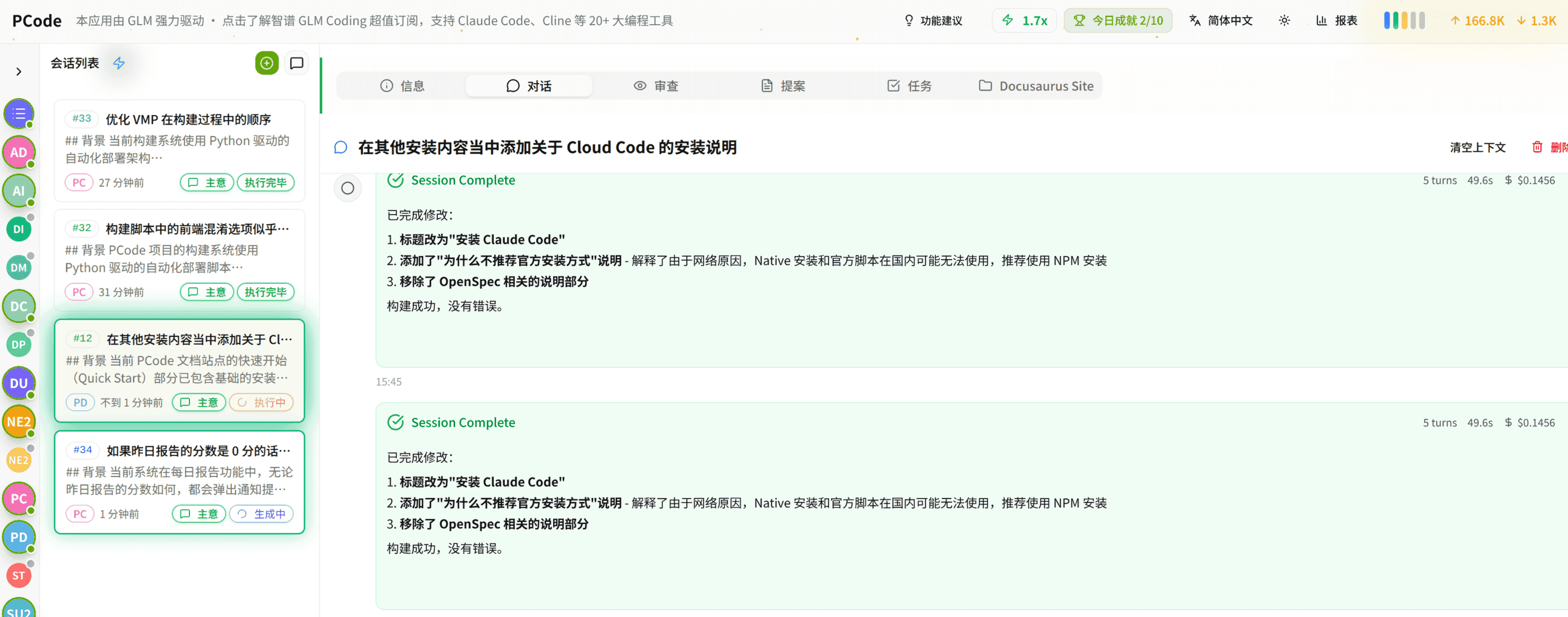
- SmartStructured workflows turn intent into an executable path from idea to shipped change.
- EfficientMulti-agent workflows keep research, implementation, and review moving in parallel.
- FunHero Dungeon interfaces make long coding sessions visual, collaborative, and rewarding.
Ecosystem Sites
Quick Links
Community
© 2026 HagiCode